
Asbestos treatment: the first Laghouat trials are encouraging
Published on 18 June 2026
At our Laghouat site, the high-frequency vitrification process has been run on test batches. The first results confirm what the research led us to expect.
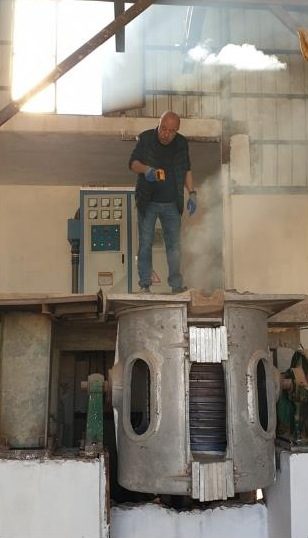
Asbestos treatment is the first process we are taking to national scale. It rests on research carried out in France by our founder, Dr Farouk Tedjar, and secured by a granted patent.
What was done
Batches of fibres were packaged and then brought to melting point in the test furnace at our Laghouat site. The molten material was poured, then cooled under controlled conditions.
The result is an inert, stable glass that no longer releases fibres. That is the whole difference between storing a hazardous waste and neutralising it.
Why temperature matters
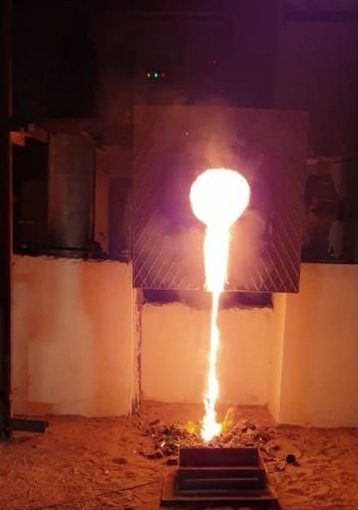
Asbestos vitrification is usually carried out at around 2,200 °C, with a plasma torch. High-frequency coupling reaches the same result at roughly 1,100 °C.
The gap is not theoretical: it shows up directly on the energy bill of a future treatment unit, and therefore on the cost per tonne for whoever holds the waste.
What this changes, and what it does not
These trials validate the process at industrial laboratory scale. They do not yet amount to a national treatment capacity: that is the next step, and the one we are preparing.
We say it here as we say it to the people we work with: the process is patented, the trials are under way, the results are encouraging. To find out where the scale-up stands at the time of your project, write to us.